Siliconstani is an identity representing Silicon Valley denizens or those associated with the High-Tech "Stan" (persian for land or place), though it could also refer to the SiliconValley-Pakistani ...
Morocco has become one of the largest winemakers in the Muslim world, with the equivalent of 35 million bottles produced last year. Wine brings the state millions in sales tax, even though Islam appears to be on the rise politically.
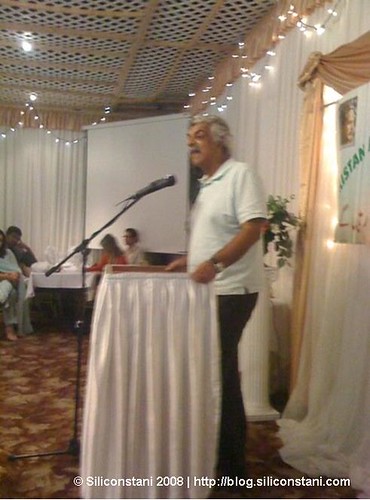
On Saturday, September, 29, 2008: The Pakistan American Democratic Forum (PADF) hosted the renowned author, Tariq Ali in Newark, California.The event was well attended by Bay Area Pakistanis of all walks of life. From the Silicon Valley Pakistani-American yuppi to Pakistanis of the wider Bay-Area, not necessarily associated to Silicon Valley.
Mr Ali discussed the current geo-political situation in Pakistan. A detailed video account of the event will be posted shortly by Cemendtaur a freelance WadiBlogger, however I'd like to highlight a few points I jotted down on my Facebook Blog:
He said "it is unfair to blame the war exclusively on Pakistan."
Ali says it's sad the Presidential candidates are promoting bombing of Pakistan. He says Pakistani-American need to organize and take lesson from their AIPAC counterpart.
Ali says frankly Muslims are under attack because of the oil that exists under Muslim lands. And Pakistans geographic location is key. He further remarks that Islam is not the enemy of the west, it's been made out to be due to the oil wealth Muslim nations are sitting on. If it were, say Buddhist nations sitting on the worlds oil reserves then we'd be hearing about Buddhists terrorists.
Ali has a colleague doing research for him and says what they've found is the language being drafted on how to deal with Muslims is similar to the language used in the 20s and 30s against Jews
Ali says Barak Obama is disappointing - he started out fine but doesn't like how he has been pushed into a corner by the system.
Ali doesn't accept Robert Fisk statement that Pakistan nuclear power is the issue. He is surprised at Fisk for making such a remark, as he is a very capable journalist, and 'no Pakistan is not the powder keg of the world.'
Tariq Ali further goes on to quotes a UNDP study: 60 percent of Pakistanis born today are stunted. He said that instead of pouring billions into combating extremism the world powers need to find ways to pump those same dollars in to social reform issues - such as overhauling the Education System in Pakistan to job creation and sustainable income generation schemes for the masses.
Jalaibi is a sweet meat from Pakistan and India. Made from flour, sugar syrup, and deep fried in oil. Great when it is pipping hot and dripping in its sugary syrup! The crusty surface, and the mushy syrupy innards makes it a delicious treat for any occasion!
Jalaibi goes well with a hot cup of Pakistani mixed-tea, or Chai. Don't forget to throw in a couple Aloo (Potato) samosa's...thus maintaining a health pH balance, between sweet and savory.
On September 13/14 Muslims from around the world will fast in honour of the Holy Month of Ramadan (Ramzan). You may be wondering why I say, September 13/14 - the answer lies in the fact there are two groups of Muslims, on the most part they are Sunni. One group is following a "fixed lunar calendar" concocted up by ISNA (Islamic Society of North America) and heavily skewed towards the Wahibist of Saudi Arabia. The other group are those who follow a somewhat more traditional calendar, based upon real time lunar observations. (see Hilal Sighting Committee).
For the next four weeks, Muslim's will refrain from eating and drinking, and as many Islamist scholars like to emphasize, refrain from sexual relations, from Dawn to Dusk.
So back to Jalaibi ! A delicious sweet...soak it in milk, or have it with dates, mix-tea, and samosas. Jalaibi and Ramzan go hand in hand. Without Jailabi, Ramzan is incomplete.
Ingredients: 1 cup maida ½ cup rice flour 2 cup water 2½ cup sugar 1 tsp. soda ¼ tsp. cream of tartar 6 green cardamom (Chhoti Ilaichi) 2 tsp. Rose water Saffron (Zafran) Yellow/orange food colour Oil/ghee for frying
Instructions: Mix maida, rice flour, soda and water and keep the mixture overnight in warm place.
Mix sugar, water, ilaichi saffron cream of tartar and cook to make it into thick syrup.
Deep fry the mixture in the curls using a nozzle like the one used for icing of cakes. Fry till light brown and pour into the syrup. DO NOT OVER SOAK. Remove and let the excess syrup drain out.
Serving: 10 to 12 persons
Eat your Jailabi, sweeten your soul from the harshness of the sweltering conflicts in the world. Conflicts, which could so easily have been avoided. From the Oil Wars to the wars between religious sects. All appear pointless after a pipping hot, sweet Jalaibi!
Wake up citizens of the world, wake up and taste the sweatiness of the Jalaibi. A sweetness that resides within us. A sweetness that is eternal, it is a sweet power that will wash over the harshness of the world. Bringing about order and serenity to chaos.
Khuda Kay liye, or translated as In the Name of God made its debut in Cinema's across Pakistan on July 20th. It made headlines around the world, amid opposition from Islamist clerics who have madly been issuing fatwa's, or religious edicts in opposition (see MSNBC's article, Defying the Fatwa) the file has become one of Pakistan's film industry, Lollywood's, biggest blockbuster hits.
The film is about the difficult situation in which the Pakistanis in particular and the Muslims in general are caught up since 9/11. There is a war going on between the Fundamentalists and the Liberal Muslims. This situation is creating a rift not only between the Western and the Muslim worlds, but also within Muslims.
The film depicts the educated and progressive Muslims are in a difficult situation because of their approach towards life and their western attire. They are criticized and harassed by the fundamentalists and on the other hand the Western world sees them as potential suspects of terrorism just because of their Muslim names. The movie revolves around a Pakistani young man (Shaan) who goes to the United States of America for higher education.
The interesting thing about the film is how it connects the happenings in the three continents. Unlike the usual Indian and Pakistani films based on romantic saga, dances and songs, this film is based on some very serious issues, raising a lot of controversial questions boggling the world around.
The Cast of the movie includes Shaan,Fawad khan,Iman Ali,Naseeruddin Shah,Hameed Sheikh, Austin Marie Sayre,Larry Neumann, Rasheed Naz, Naeem Tahir, Seemin Raheel, Humayun kazmi, Najeeb Ullah Anjum, Ayub Khosa, Rufus Graham, Angela Williams & Alex Edwards.
BackGround Music: Rohail Hayat
Vocals : Ahmad Jahanzeb, Shuja Haider, Farah Zala, Ammar Hassan Khawar Jawwad, Faiza Mujahid, Saeen Zahoor, Zara Madani
Lyrics : Shoib Mansoor; Bhule Shah; Faiza Mujahid
Songs Composed By : Ahmad Jahanzeb, Shuja Haider, Lagan Band, Khawar Jawad, Jawwad Bashir.
Trailer of the Movie:
Search for other clips and sound tracks on the movie here.
50-Minute Discussion on Movie on GEO TV: Guests- Hina Jilani, Robina Sehgal, Molana Ahmed Ali Qasoor, Dr Farooq Khan
Part 1/4
Part 2/4
Part 3/4
Part 4/4
AAJ TV Discussion on Controversial parts of the Movie: Host - Dr. Aamir Liaquat, Guests- Shabir Ahmed Azhari and Dr. Shakeel Ouj
A mockery of a discussion this is. How can you have a discussion when the entire panel come from the same view point?
Over the past year, since I moved to the Silicon Valley I have been interacting with various community groups and organizations. Paying lip-service to many, and endorsing a few fully where I was able to engage with folks who were on a similar thought pattern as mine.
I wont name names here, but every organization or project I would attempt to dangle my feet in, I would very quickly start thinking on how to get out. Initially every entity looks attractive from the outside.
An openness to accept new ideas is missing in this community. If you try to make statements other than what is acceptable within the context of a certain ideological framework, you will surely find yourself out numbered and marginalized by the vast majority. It's as if there is a deliberate attempt by the Silicon Valley Pakistan and Muslim communities on a whole to shun out all-things-other, that is all things that don't related to religion and money.
The turn out was OKAY, but not great - I expected far more people, as there are a sizable number of Pakistanis in the Silicon Valley and Bay Area in general who have heard and read Mohsin Hamid's novels.
Further, in the recent Sahil Bachao campaign I helped spearheaded in the Silicon Valley, as part of the larger team effort in Karachi, Pakistan there was little interest displayed by the BayArea Pakistanis. My question is, aren't there any Pakistanis out here that have any iota of interest left for all-things-other than religion? If an event or cause doesn't make explicit reference to religion or making money, then it is not important. This seems to be the mainstream attitude amongst Silicon Valley Pakistanis and Muslims in general.
Many a times it is extremely frustrating dealing with the vast majority of the Silicon Valley Muslim and to some extent Pakistani communities who will brand you as "kafir" (unbeliever) upon the slightest notion that your views are not compliant to theres. This is a largely educated Muslim community, highly professional working in several of the fortune technology companies - however to much a due quite insular and impervious to listening to all-things-other than religion.
This intolerance to all-things-other, is a trait which is found in much of the Muslim world. Exactly the reason novel ideas aren't able to take root. How is a society to progress with such an attitude that shuns at all that don't see eye-to-eye with them. There is more to life than just religion and money, what about enhancing once culture, or rather cultures in the case of Muslims who come from a large cultural spectrum.
Culture is one of the all-things-other that has been shunned to the side, and replaced with religion. Religion is good, but not the only thing - there is much more to life. Your faith is merely a component, an important component mind you of your life.
Siliconstani is the blog name that emerged out of the concept of representing the Silicon Valley Pakistani and representing a global community whom are professional rooted in Silicon Valley, yet ethnically and ideologically have roots in the regions in and about Pakistan. Siliconstani was founded by Abdulrahman Rafiq in February of 2006 with the first post on social innovation.



 On Saturday, September, 29, 2008: The


