Thursday, March 29, 2007

Ask what you can do...JFK - Kennedy's innuugral speech...

"...ask not what your country can do for you, ask what you can do for your country." These were words uttered by President John F. Kennedy (JKF). A highly respected and loved President America has ever had. These are not mere words to be taken at face value but are to be imbibed and contemplated. As there is a powerful messages here.

The country is not some obscure entity out there, in fact it is a real living, breathing entity. An entity which comprises of individuals like you and me. The country exists becuase of you. You are the heart and soul of the country. This is what President Kennedy was getting at.

He further when on to address the world "...ask not what American can do for you, ask what we can do for the world." Indeed another power statement, ask what as a community of nations can do for the world. What we can as a collective do to promote world peace and mutual respect and coexistence amongst one another.

These days such great men with such lofty ideals are hard to come by.

Following is the complete video of JFK's inaugural address. Listen to it, imbibe it and live it...the world is at a critical cross-road, where will we the inhabitants of this planet steer it's future. As the power to govern is within us, governments and countries exist becuase of us. You have the POWER within you to make a difference...

JKF Inaugural Address Part 1:


JKF Inaugural Address Part 2:


Copyright C. Abdulrahman Rafiq (ARR)

Re: [sv-pak] From Pakistan to SF

Indeed a sordid comparison it is. Life in the Silicon Valley vs. life in Pakistan, or for that matter anywhere else. Even here in the United States the Silicon Valley isn't the norm. Technology is the life line of this region, iPod's to iPhones - laptops, PDA's you name it are prevalent here.

Not that they aren't in Pakistan, yes they are but the difference is they are seen as luxury items. Like say high-speed internet connection such as DSL or Cable. It is seen as a luxury item, even though the DSL service from some of the name brand carries such as CyberNet really "suck", they are slower than Dial in services - or so has been my experience.

The Silicon Valley, a singularity in the space-time continuum it is. Take a trip to Southern California and you will find it is a whole other world out there technology though as prevalent as here int he SF Bay, it doesn't dominate the pop culture of SoCal as it does here in the Bay.

Recently, a fellow Wadiite, a well known blogger who goes by the by line of iFaqeer did a Video segment on Technology in Society.


-AR


Zunaira Durrani <zunaira.durrani@gmail.com> wrote:
From Pakistan to SF (External article hyperlink follows my own comments)

In other news, Zamir Haider has written a sordid comparison of life in
Islamabad and San Francisco. According to Haider, he doesn't see iPods
in Islamabad and the sight of a Pentium 4 in Pakistan would shock
many. For the record, Illusion in Jinnah Super sells all models of
iPods the moment they hit the market in the US--people carry them to
work and play. Of course, I don't need to remind anybody people are
fairly mad about keeping their computers updated.

The point is, why does Haider paint such a backwater-caveman picture
of a major Pakistani city to CNet editors? It is already easy to sell
the idea that we live in the dark ages back in Pakistan to the media
here--thanks to Fox. I'm so gutted! :( Read on....

From Pakistan to S.F., it's a whole new tech world
In Northern California, iPods are everywhere and everyone talks about
the latest in gadgets. In Islamabad, not so much.
By Zamir Haider

http://news.com.com/From+Pakistan+to+S.F.%2C+its+a+whole+new+tech+world/2100-1041_3-6171019.html
__._,_.___


Tuesday, March 27, 2007

TCF - Nurturing Pakistan's Future....one child at a time....

Cupertino, March 23, 2007: The Silicon Valley Pakistani-American community organized a stupendous event commemorating Pakistan's republic day. It was on this day 57 years ago that the All India Muslim league met in Lahore to draft the Lahore resolution, which later came be known as the Pakistan Resolution. This document stipulates the creation of a separate homeland for the Muslims of the the Indian Sub-Continent, for a historical prospective see my March 20th post.

The event was well attended by individuals from all walks of the SiliconWadi life. You had people from the SiliconWadi legal fraternity, to the typical Techie Pakistani, to representatives from Congressman Mike Honda's office., to members of the RagingGranies group. The sponsors of the event were Izaan Corporation, Mirchi Cafe, The Citizen's Foundation and several other individuals and Pakistani well wishers from the San Francisco Bay Area.

Net proceeds from the ticket sales were donated to The Citizen's Foundation. The event agenda consisted of community based entertainment, talks and presentations by the The Citizen's Foundation CEO General (rtd) S.P. Shahid, not to mention the final entertainers were like visits from the past. One such visit was by Nahid Naizi, this is someone who was well known and loved back in the 1960's in Pakistan - well before my times. The other was Alamgir, whose fame reached its pinnacle around the mid to early 1980's.

Listening to Alamgir sing sent me on a nostalgic journey down memory lane, where I was transported back to my school days, particularly when he sang "Mehney tumharee gaagar sey kabhi pani piya tha...." Oh gee-wizz 'tis was a trip down nostalgia lane. A mere school boy I was then, performing in the annual C.A.S. School play with this particular song as the background music!

However, we mustn't loose sight of the actual purpose of the event, which was centered around the The Citizen's Foundation (TCF).

TCF is a not for profit charity organization, founded in August of 1995 in my hometown Karachi, Pakistan with the explicit purpose to promote education and make a difference for the vast majority of Pakistan's children living under extreme dire circumstances.

TCF since its inception has grown into a multi million dollar charity, benefiting countless children across the length and breadth of Pakistan. They have amassed a following both within and without the country with chapter groups being established all across the world. Here in the U.S. we have TCF-USA which was the sponsoring chapter for this event in the Silicon Valley.

Upon speaking with the TCF USA leadership team, Mr Amjad Noorani and Daniel Noorani, and the CEO General S.P. Shahid I found myself converted from being a skeptic to a follower. Indeed this is an organization that has and is doing a great deal of good work in Pakistan.

TCF USA has also been active in forming alliances with Corporate groups, such as the Microsoft Pakistani Employees and Cisco Pakistani employees who have managed to get TCF USA on to the list of approved charities for Cisco dollar-for-dollar matching program.

Following is a film that was directed and produced by some friends from Newsline Video in Karachi.

Against The Tide - The TCF Story Part I


Against The Tide - The TCF Story Part II


Following is an introduction to TCF, this Video was also presented by General (rtd) S.P. Shahid at the Pakistan Day event in the Silicon Valley


Click to make a donation to TCF
TCFUSA is a non-profit organization registered under section 501(c)(3) of the IRS code

Corporate employees please check with your respective Human Resource departments if TCF USA is a charity approved for matching funds before making any donation.


Copyright C. 2007 Abdulrahman Rafiq (ARR)

Fwd: [pakeditor] Pakistan's Silent Majority Is Not to Be Feared - NYTIMES - THE GREAT GAME CONTINUES....

An Excellent piece by Mohsin Hamid. Indeed he is one the many Pakistanis who believed in Musharraf, but are now utterly disappointed. Many of us in the past went so far as to defend his policies claiming that finally Pakistan has gotten a leader who has put the best interest of the country before his/her own. Indeed this is what he portrayed when he first annexed the reigns of government from the "democratically" elected representative.

How naive could we have been, the writing was on the wall all around us. The pawns were being put in place, Musharraf but one of the many pawns in the Great Game played in recent years by imperialistic powers in South Asia and the greater Central Asian region.

So now whats next? Madam Pinky is it to be you, or who? Who will it be that convinces the powers that they are the next best thing for Pakistan, that they have the solution to regional stability? And so the Game continues - a Game it is indeed, a struggle for controlling a region that are considered "Emerging Markets" by some, or seen by others as a source of immense wealth, fueling economies around the world.

-ARR

[The article was initialed posted to pakeditor@yahoogroups.com]

Copyright (c) 2007 Abdulrahman Rafiq

Syed Asif Alam <asifalam@aopp.org> wrote:
To: editor@aopp.org
From: Syed Asif Alam <asifalam@aopp.org>
Date: Tue, 27 Mar 2007 16:07:29 -0700 (PDT)
Subject: [pakeditor] Pakistan¢s Silent Majority Is Not to Be Fe
ared - NYTIMES

March 27, 2007
Op-Ed Contributor

Pakistan's Silent Majority Is Not to Be Feared

London
I WAS one of the few Pakistanis who actually voted for Gen. Pervez Musharraf in the rigged referendum of 2002. I recall walking into a polling station in Islamabad and not seeing any other voter. When I took the time required to read the convoluted ballot, I was accosted by a man who had the overbearing attitude of a soldier although he was in civilian clothes. He insisted that I hurry, which I refused to do. He then hovered close by, watching my every action, in complete defiance of electoral rules.
Despite this intimidation, I still voted in favor of the proposition that General Musharraf, who had seized power in a coup in 1999, should continue as Pakistan's president for five more years. I believed his rule had brought us much-needed stability, respite from the venal and self-serving elected politicians who had misgoverned Pakistan in the 1990s, and a more free and vibrant press than at any time in the country's history.
The outcome of the referendum — 98 percent support for General Musharraf from an astonishing 50 percent turnout — was so obviously false that even he felt compelled to disown the exercise.
Rigged elections rankle, of course. But since then, secular, liberal Pakistanis like myself have seen many benefits from General Musharraf's rule. My wife was an actress in "Jutt and Bond," a popular Pakistani sitcom about a Punjabi folk hero and a debonair British agent. Her show was on one of the many private television channels that have been permitted to operate in the country, featuring everything from local rock music to a talk show whose host is a transvestite.
My sister, a journalism lecturer in Lahore, loves to tell me about the enormous growth in recent years in university financing, academic salaries and undergraduate enrollment. And my father, now retired but for much of his career a professor of economics, says he has never seen such a dynamic and exciting time in Pakistani higher education.
But there have been significant problems under General Musharraf, too. Pakistan has grown increasingly divided between the relatively urban and prosperous regions that border India and the relatively rural, conservative and violent regions that border Afghanistan. The two mainstream political parties have historically bridged that divide and vastly outperformed religious extremists in free elections, but under General Musharraf they have been marginalized in a system that looks to one man for leadership.
What many of us hoped was that General Musharraf would build up the country's neglected institutions before eventually handing over power to a democratically elected successor. Those hopes were dealt a serious blow two weeks ago, when he suspended the chief justice of Pakistan's Supreme Court, Iftikhar Mohammad Chaudhry.
For General Musharraf, Justice Chaudhry had become a major irritant. He had opened investigations into government "disappearances" of suspects in the war on terrorism. He had blocked the showcase privatization of the national steel mill. He had, in other words, demonstrated that he would not do General Musharraf's bidding. With elections due later this year, and challenges to irregularities like the rigging that took place in 2002 likely to end up in the Supreme Court, an independent chief justice could jeopardize General Musharraf's continued rule.
Like many Pakistanis, I knew little about Justice Chaudhry except that he had a reputation for being honest, and that under his leadership, the Supreme Court had reduced its case backlog by 60 percent. His suspension seemed a throwback to the worst excesses of the government that General Musharraf's coup had replaced, and it galvanized protests by the nation's lawyers and opposition parties, including rallies of thousands in several of Pakistan's major cities yesterday.
More troubling still was the phone call I received recently from a friend who works for Geo, one of Pakistan's leading independent television channels. The government had placed enormous pressure on Geo to stop showing the demonstrations in support of Justice Chaudhry, and the channel had refused to comply. When my friend told me that policemen had broken into Geo's offices, smashed its equipment and beaten up the staff, I felt utterly betrayed by the man I had voted for.
Despite his subsequent apology for the Geo incident, General Musharraf now appears to be more concerned with perpetuating his rule than with furthering the cause of "enlightened moderation" that he had claimed to champion. He has never been particularly popular, but he is now estranging the liberals who previously supported his progressive ends if not his autocratic means. People like me are realizing that the short-term gains from even a well-intentioned dictator's policies can be easily reversed.
General Musharraf must recognize that his popularity is dwindling fast and that the need to move toward greater democracy is overwhelming. The idea that a president in an army uniform will be acceptable to Pakistanis after this year's elections is becoming more and more implausible.
The United States has provided enormous financial and political support to General Musharraf's government, but it has focused on his short-term performance in the war on terror. America must now take a long-term view and press General Musharraf to reverse his suspension of the chief justice and of Pakistan's press freedoms. He should be encouraged to see that he cannot cling to power forever.
Pakistan is both more complicated and less dangerous than America has been led to believe. General Musharraf has portrayed himself as America's last line of defense in an angry and dangerous land. In reality, the vast majority of Pakistanis want nothing to do with violence. When thousands of cricket fans from our archenemy, India, wandered about Pakistan unprotected for days in 2004, not one was abducted or killed. At my own wedding two years ago, a dozen Americans came, disregarding State Department warnings. They, too, spent their time in Pakistan without incident.
Yes, there are militants in Pakistan. But they are a small minority in a country with a population of 165 million. Religious extremists have never done well in elections when the mainstream parties have been allowed to compete fairly. Nor does the Pakistan Army appear to be in any great danger of falling into radical hands: by all accounts the commanders below General Musharraf broadly agree with his policies.
An exaggerated fear of Pakistan's people must not prevent America from realizing that Pakistanis are turning away from General Musharraf. By prolonging his rule, the general risks taking Pakistan backward and undermining much of the considerable good that he has been able to achieve. The time has come for him to begin thinking of a transition, and for Americans to realize that, scare stories notwithstanding, a more democratic Pakistan might be better not just for Pakistanis but for Americans as well.
Mohsin Hamid is the author of "Moth Smoke" and the forthcoming novel "The Reluctant Fundamentalist."
__._,_.___


Tuesday, March 20, 2007

Significance of 23rd March...Pakistan Day

In three days Pakistanis worldwide will be commemorating 23rd March, or Pakistan's Republic Day, this is the day that Pakistan became the first Islamic Republic in the world (1956). It is also the date of the Lahore Resolution (Qarardad-e-Pakistan or the then Qarardad-e-Lahore), was passed at the Annual General Convention of the All India Muslim League (1940).

It is celebrated with parades in Islamabad that involve both military contingents, such as the Pakistan Armed Forces and Paramilitary Forces, as well as civilian ones. A special investiture ceremony is also held in the Presidents house to bestow titles and awards to military and civilian recipients. The events are televised via Pakistan's National Television (PTV). As a young boy I recall looking forward to waking up early on the Morning of 23rd March to watch the 23rd March parade on Television.

Right: Working Committee - All India Muslim league, Lahore Session, 23rd March 1940

I did also once attend the parade live in Islamabad (the Capitol city of Pakistan). Sitting along Constitution Avenue in pouring rain was a day to remember.


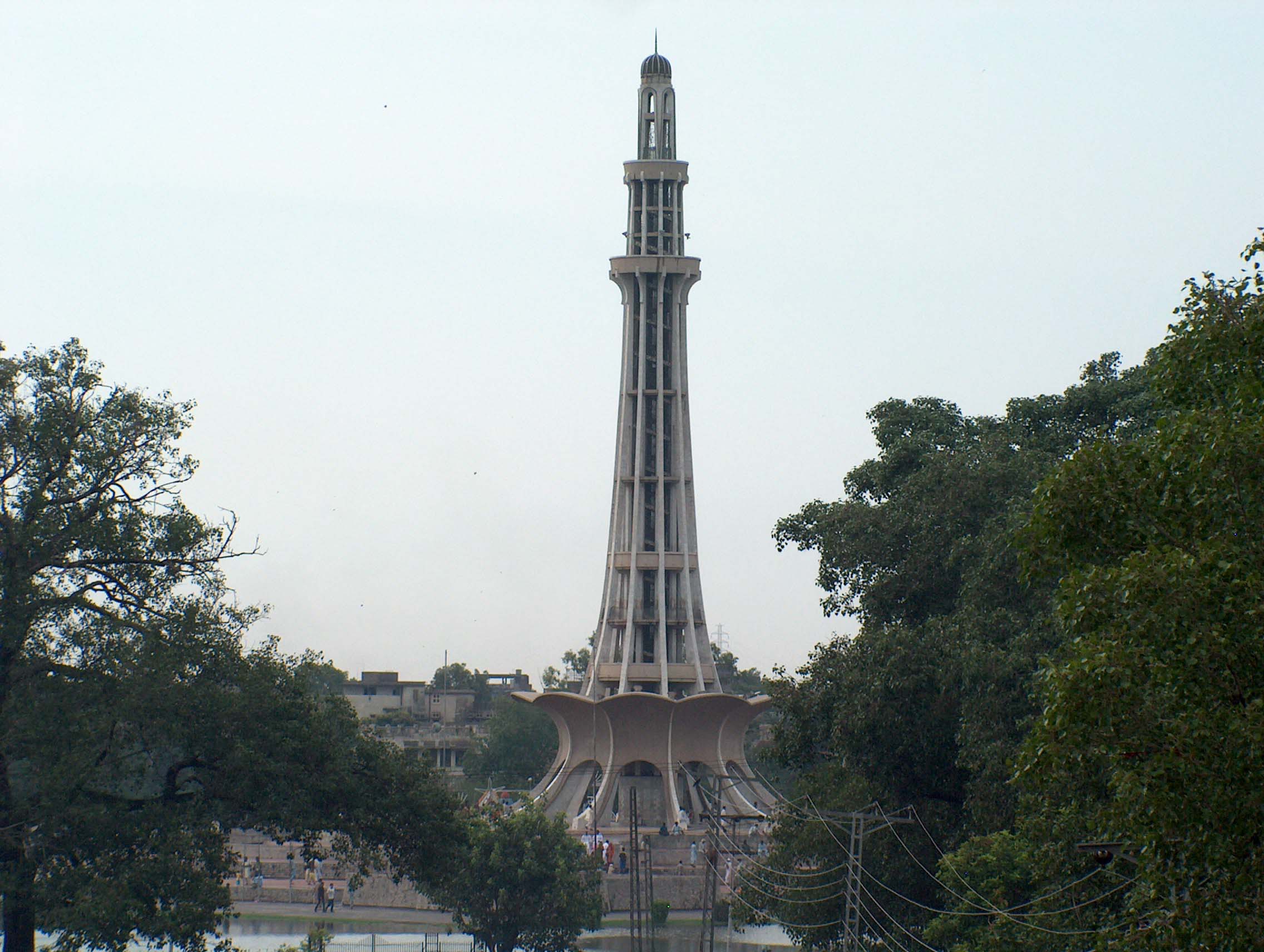
Right: Minar-e-Pakistan, Lahore stands at a place where Muslim delegations from all over India gathered to pass the Lahore Resolution, which later came to be known as the Pakistan Resolution


To learn more about the the Lahore Resolution read article by Pakistan Times


National Anthem of Pakistan:


The Original Words - In Roman Urdu

Pak sar zamin shad bad
Kisware haseen shad bad
Tu nishane azmealishan
arze Pakistan
Markaz e yaqin shadbad.
Pak sarzamin ka nizam,

quwat e akhuwat e awam
Qaum, mulk, sultanat
Painda tabinda bad,
shad bad manzal e murad.
Parcham e sitara o hilal
Rahbar e tarraqi o kamal
Tarjuman e mazi shan e hal

jane istaqbal
Sayyai, Khudae zul jalal.


English Translation

Blessed be sacred land,
Happy be bounteous relam,
Symbol of high resolve,
Land of Pakistan.
Blessed be thou citadel of faith.
The Order of this Scared Land
Is the might of the brotherhood of the people.
May the nation, the country, and the State
Shine in glory everlasting.
Blessed be the goal of our ambition.
This flag of the Cresent and the Star
Leads the way to progress and perfection,
Interpreter of our past,
glory of our present,
Inspiration of our future,
Symbol of Almighty's protection


Copyright (c) 2007 Abdulrahman Rafiq


A forgotten people....Pakistan's dilemma

Forgotten and stranded, perhaps once 36 years ago you could call them stranded Pakistan's in East Pakistan (present-day Bangladesh). Granted it was then the Pakistani government should have acted and arranged to airlift these folks out of the region. But it never happened, and 36 years have past. Why now, frankly however sad this may be Pakistan just simply cannot accommodate 250,000 to 500,000 new immigrants. We are barely able to cope with the present 160M+ population, how are we to accommodate 500,000+ new immigrants?

These are some of the harsh realities of war, a war which shouldn't have happened but it did. A war which could have been prevented,I say this as a student of history. An age old issue which dates back to the 1950's.

It is a dilemma indeed, however incorporating half a million immigrants into the Federation of Pakistan is out of the question. We simply can't handle it, our cities aren't equipped for a sudden influx a large mass of people.

Some may argue it is immoral not to admit these "stranded Pakistanis" into the Federation, but it is even more immoral to admit them - as it simply will not be fair. They would be worse off than they are now. To restart life in a new land is not easy - especially in a country with a growing population of 160M+.

The next best option is for these people to accept Bangladeshi citizenship and integrate themselves into that society.

Following are some video documentaries on the sad fate of the "Stranded Pakistanis" - so is the harsh reality of war.

Video: stranded Pakistani's in Bangladesh...


Video: Stateless in Bangladesh


Video: Camps of Bangladesh


"Stateless Bihari's in Bangladesh, an humanitarian nightmare" Paper by Global Policy Forum

Is there a solution other than admitting these people into the Pakistan Federation?

Most Recent News Clips:


Begum Khalida Zia meets with Shuakat Aziz in Islamabad....one of the issues of discussion is the fate of the stranded Pakistanis (January 2006). Also see http://www.bdhcpk.org/index.php?link=pics#.
And also see report by Jang.

7 Member Delegation from Stranded Pakistanis in Bangladesh meet with Babar Khan Ghouri, Federal Minister for Ports and Shipping


Copyright C. Abdulrahman Rafiq